
Most dog shampoo ingredient lists read like a chemistry exam. Most are fine. Some are not. This guide focuses on the small set of ingredients with solid evidence behind avoiding them, what each does, what it’s listed as, and why. It’s not a “natural is always better” rant — some of the worst ingredients in dog shampoo are extracts of plants, and some of the best are synthetic.
Avoid: sulfates (SLS, SLES), formaldehyde-releasing preservatives, methylisothiazolinone, synthetic dyes, artificial fragrance, parabens, and phthalates. Look for: plant-derived glucoside or glutamate cleansers, named essential oils (not “fragrance”), and simple preservatives like phenoxyethanol.
1. Sulfates (SLS, SLES, ALS, ALES)
What they do: Strong cleansers that strip oil and dirt from coat and skin. Produce thick foam.
Why avoid: They don’t distinguish between dirty oil and the natural oils that protect the skin. With frequent use they damage the skin barrier, dry out the coat, and over time can contribute to chronic skin conditions in sensitive dogs.
Look for on labels: “Sodium Lauryl Sulfate,” “Sodium Laureth Sulfate,” “Ammonium Lauryl Sulfate,” “Ammonium Laureth Sulfate.” Sometimes spelled with European chemical naming.
Honest take: Sulfates aren’t acutely dangerous, but cumulatively they cause more problems than they’re worth, especially for dogs bathed more than monthly. The replacement ingredients are well-developed at this point — there’s no reason to keep using sulfates.
2. Methylisothiazolinone (MIT) and Methylchloroisothiazolinone (CMIT)
What they do: Preservatives that prevent bacterial growth in the bottle. Very effective at low concentrations.
Why avoid: Both are documented contact allergens. The EU banned them in leave-on products in 2017 due to skyrocketing reaction rates in people. They’re still common in US dog shampoos despite causing similar reactions in dogs.
Look for on labels: “Methylisothiazolinone,” “Methylchloroisothiazolinone,” sometimes “MIT,” “CMIT,” or “Kathon CG” (a trademark name).
Better alternatives: Phenoxyethanol, sodium benzoate, potassium sorbate — all do the same preservation job with much lower allergy rates.
3. Formaldehyde-releasing preservatives
What they do: Slowly release tiny amounts of formaldehyde to preserve the product. Also very effective.
Why avoid: Formaldehyde is a known carcinogen. The amounts released by these preservatives are small, but they accumulate with repeated exposure. Dogs that are bathed weekly with a formaldehyde-releasing shampoo are getting small repeated doses.
Look for on labels: “DMDM Hydantoin,” “Imidazolidinyl Urea,” “Diazolidinyl Urea,” “Quaternium-15,” “Bronopol,” “5-Bromo-5-Nitro-1,3-Dioxane.”
Honest take: A single use of a shampoo with a formaldehyde-releaser isn’t going to harm your dog. The case for avoiding them is about cumulative exposure across thousands of baths over a dog’s life.
4. Artificial fragrance (“Fragrance” / “Parfum”)
What they do: Make the product smell good. The single word “fragrance” can legally cover dozens of unlisted compounds.
Why avoid: Two reasons. First, fragrance is the second most common cause of contact reactions in dogs after sulfates. Second, you have no idea what’s actually in it — manufacturers don’t have to disclose fragrance composition because it’s considered trade secret.
Look for on labels: “Fragrance,” “Parfum,” sometimes “Perfume.” Genuine essential oils are listed by their specific names (e.g., “Lavandula Angustifolia Oil” for lavender).
Better alternatives: Properly formulated essential oils at safe concentrations. A small amount of named lavender, peppermint, or rosemary oil provides scent without the unknown-compound problem.
5. Synthetic dyes (FD&C colors)
What they do: Make the shampoo blue, green, or pink. Purely cosmetic.
Why avoid: No cleaning benefit, no functional purpose, and a meaningful percentage of dogs react to them. Some FD&C dyes have also been linked to long-term health concerns in lab studies (which is why several have been removed from human food).
Look for on labels: “FD&C Blue No. 1,” “D&C Red No. 33,” etc. Any “FD&C” or “D&C” prefix.
Honest take: Dye in dog shampoo is the easiest call on this list. There is no upside whatsoever. Avoid it.
6. Parabens
What they do: Preservatives. Like the others above, they prevent bacterial growth.
Why avoid: Endocrine disruptors — they mimic estrogen at low levels. The amounts in shampoo are small, but the cumulative exposure question applies as with formaldehyde-releasers.
Look for on labels: Any ingredient ending in “-paraben”: methylparaben, propylparaben, butylparaben, ethylparaben.
Honest take: Of the items on this list, parabens have the weakest evidence of acute harm. They’re banned in some countries out of precaution rather than from clear evidence of damage from shampoo use. Still worth avoiding if you have other options.
7. Phthalates
What they do: Used as solubilizers (helping fragrance oils mix with water) and as plasticizers.
Why avoid: Documented endocrine disruptors, particularly affecting reproductive hormones. Strong evidence base from human studies.
Look for on labels: Often not listed individually but hidden under “fragrance.” Some explicit names: “Diethyl Phthalate (DEP),” “Dibutyl Phthalate (DBP).”
Better approach: Choose products with no listed fragrance, or with specific essential oils listed individually — these don’t need phthalate solubilizers.
8. Triclosan
What it does: Antibacterial agent. Used to add “germ-killing” claims to products.
Why avoid: Contributes to antibiotic resistance. Also disrupts the skin microbiome — the bacteria normally on the skin that help maintain barrier function.
Look for on labels: “Triclosan” or sometimes “Triclocarban.”
Honest take: Triclosan has been phased out of most consumer products and is less common than it used to be. Worth checking, especially in older formulations or imported products.
What to look for instead
A good dog shampoo ingredient list is short and readable. Here’s roughly what you should see:
Look at the first 5 ingredients. If you see a sulfate, fragrance, or dye there, the rest of the label doesn’t matter — the product isn’t gentle. If the first 5 are water, a glucoside-family cleanser, glycerin, and an oil, you’re probably looking at a well-formulated product.
Greenwashing watch-outs
A few claims to look at with skepticism:
“Natural” — Essentially unregulated in dog products. Means whatever the manufacturer wants it to mean. Read the actual ingredient list.
“With organic ingredients” — Could mean one of the seventeenth-listed ingredient is organic. Look at how prominently any organic ingredient appears.
“Vet-approved” — Often means one vet was paid to consult. Doesn’t mean clinically tested. Look for specific certifications or studies.
“Tear-free” / “Hypoallergenic” — Both terms have no regulatory definition. They’re marketing claims.
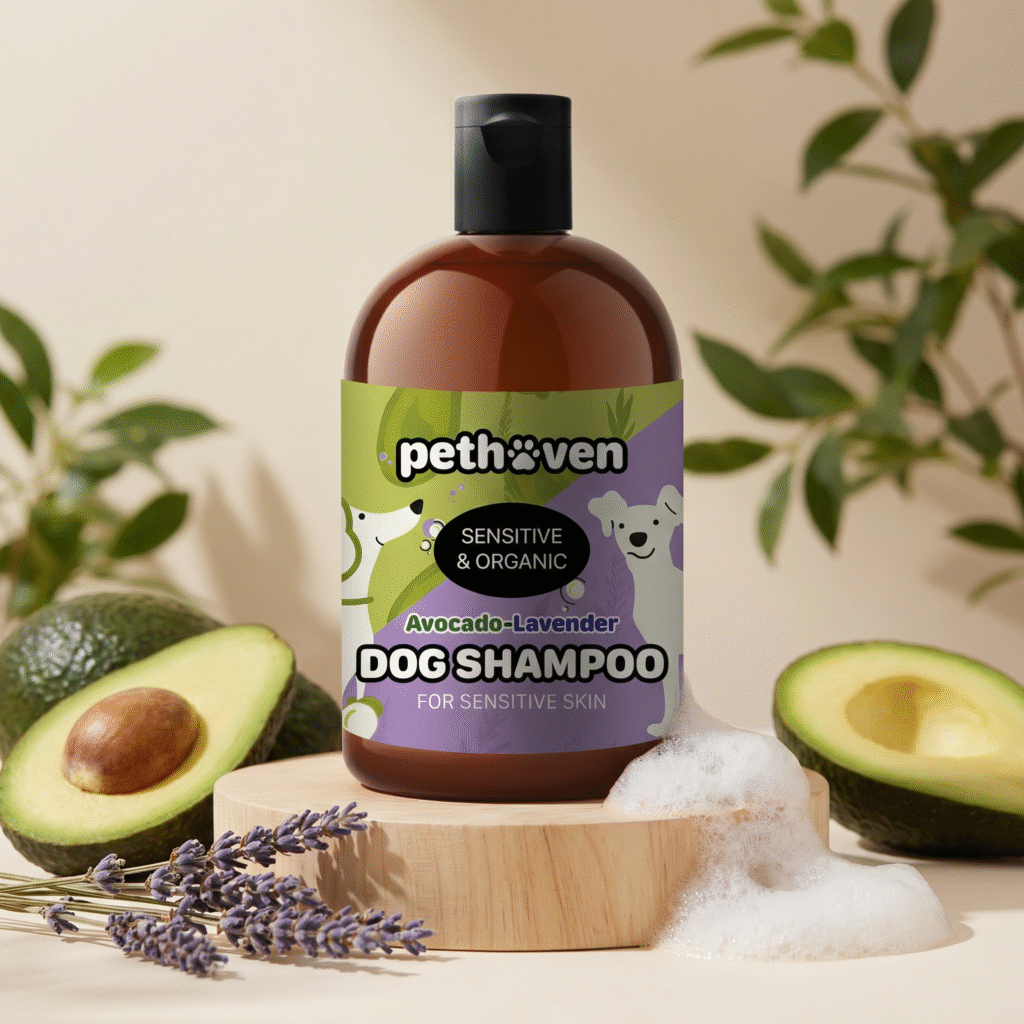 Avocado-Lavender Shampoo" title="What Ingredients to Avoid in Dog Shampoo: A Plain-English Guide">
Common questions
Is “fragrance-free” the same as “unscented”?
No. “Fragrance-free” means no fragrance was added. “Unscented” can mean masking fragrances were added to cover the smell of other ingredients — so it has fragrance, just designed to be neutral-smelling. Look for “fragrance-free.”
What if a shampoo has just one ingredient on this list?
Depends on which one. A trace of phenoxyethanol is fine. SLS as the second ingredient is not. Use the list as a guide, not a strict rule.
Should I worry about my dog’s current shampoo?
If your dog has no skin issues and the shampoo has only minor items on the list, probably not worth a panicked switch. If your dog has any skin sensitivity signs or the shampoo has multiple items on the list, switching is worth doing.
Are essential oils always safe for dogs?
No. Some are toxic to dogs at any concentration (tea tree, citrus, pennyroyal). The ones used in mainstream dog shampoos (lavender, peppermint, rosemary, chamomile) are safe at low concentrations. Stay away from concentrated essential oils — even safe ones — applied directly to skin.