
“Sulfate-free” is now on roughly half of all dog shampoo bottles. It’s also one of the most loosely-defined terms in the industry. A product can technically be sulfate-free while still containing ingredients that do essentially the same damage. And many products claim to be sulfate-free while not actually being so — they just don’t list sulfates in plain English.
This is a practical guide to what sulfates actually are, why they matter, and how to tell whether a “sulfate-free” claim is real or marketing.
Sulfates are aggressive cleansers (most commonly SLS and SLES) that strip oils from skin and coat. “Sulfate-free” is meaningful when it’s combined with mild plant-based alternatives. It’s marketing when the product replaces sulfates with similarly harsh chemicals that just don’t have “sulfate” in the name. Check the full ingredient list, not just the front of the bottle.
What sulfates actually are
Sulfates in shampoo are a family of chemical compounds called anionic surfactants. Surfactants are molecules with two ends: one end loves water, the other end loves oil. When you mix them with water and rub them on something oily (like a dirty dog), they grab the oil at one end and water at the other, lifting the oil off the surface and washing it away.
The most common sulfates in shampoo are:
- Sodium Lauryl Sulfate (SLS) — the most aggressive of the common ones. Excellent cleaner, harsh on skin.
- Sodium Laureth Sulfate (SLES) — slightly gentler than SLS but still strong. Often used in “gentle” formulas that aren’t actually gentle.
- Ammonium Lauryl Sulfate (ALS) — similar to SLS, sometimes substituted in.
- Ammonium Laureth Sulfate (ALES) — similar to SLES.
All four work the same way: they cut through oil very effectively, generate a lot of foam (which most people associate with “cleaning”), and are cheap to produce. That’s why they ended up in virtually every shampoo on earth for decades.
Why they’re a problem for dogs
Sulfates don’t distinguish between dirt-oil and skin-oil. They cut through both. On human skin, this matters less because our skin barrier is relatively thick. On dog skin — which is actually thinner than human skin, by about a third — it matters more.
Repeated sulfate use damages a dog’s skin in three measurable ways:
Skin barrier disruption. The skin’s outer layer is held together partly by lipids — fats that keep it waterproof and protect against allergens. Sulfates wash those lipids out. Without them, water leaves the skin (causing dryness) and irritants enter the skin (causing itch and inflammation).
Coat dullness. The natural oils in a healthy coat give it shine and water resistance. Strong sulfates remove those oils every wash. With time, the coat looks dull and feels brittle even between baths.
Cumulative sensitivity. Dogs that didn’t react to sulfates at first can develop reactions over months or years as the skin barrier weakens. This is why “they’ve used the same shampoo for years and now suddenly they’re itchy” is such a common owner observation.
Why sulfates are still in most products
Two reasons. First, they’re cheap — a bottle of SLS costs a fraction of a bottle of plant-derived surfactant. Second, they produce the foamy lather that most people associate with cleanliness. A mild plant-based shampoo lathers less, and shoppers often interpret that as “not working.” Brands know this, so they keep using sulfates even in “gentle” formulas.
The foam in your dog’s bath isn’t doing the cleaning. The surfactant is. You can have effective cleaning without aggressive foam — and that’s where modern plant-based formulas have changed the game.
The “marketing sulfate-free” trick
Here’s where it gets frustrating. A product can claim to be sulfate-free while containing ingredients that do nearly the same damage. The two most common substitutes you’ll see on “sulfate-free” labels:
Not all “coconut-derived” cleansers are equal, and a “sulfate-free” claim doesn’t tell you whether the actual cleanser used is gentle. The full ingredient list does.
What a genuinely gentle cleanser looks like
If a shampoo is truly mild, the ingredient list will include cleansers from the following family:
How to read a label in 60 seconds
Usually within the first 5 ingredients. Look for the word “lauryl” (often paired with “sulfate” or “sulfonate”) as a warning sign. Look for “glucoside” or “glutamate” as a good sign.
“Fragrance” or “parfum” as ingredients can hide dozens of compounds. A genuinely gentle product either has no added fragrance or uses specific essential oils named individually (e.g., “lavandula angustifolia oil” for lavender).
Look for “FD&C” or “D&C” followed by a color name and number (“FD&C Blue No. 1”). These are synthetic dyes. No medical or cleaning purpose, common allergen.
Avoid methylisothiazolinone (MIT), methylchloroisothiazolinone (CMIT), and formaldehyde-releasers (DMDM hydantoin, quaternium-15, imidazolidinyl urea). Look for milder ones: phenoxyethanol, sodium benzoate, potassium sorbate.
If a shampoo lathers up massive foam from a small amount of product applied to a wet coat, that’s usually a high-sulfate formula. Genuine mild plant-based formulas lather less. Less lather doesn’t mean less clean.
When sulfate-free matters most
Some dogs handle sulfates fine for years and never have issues. Others develop problems quickly. The dogs that benefit most from a switch to genuine sulfate-free formulas are:
- Dogs bathed weekly or more often (apartment dogs, allergy dogs on bath schedules)
- Puppies under one year (developing skin barrier)
- Senior dogs (thinner, drier skin)
- Dogs with any sensitive skin signs (itching, flaking, dullness)
- Breeds with known sensitive skin (Frenchies, Westies, Goldens, Bulldogs)
If your dog has been on the same sulfate shampoo for years without issues and shows no signs of skin problems, you don’t have to switch. But if any of the above apply, switching is a small change with significant potential upside.
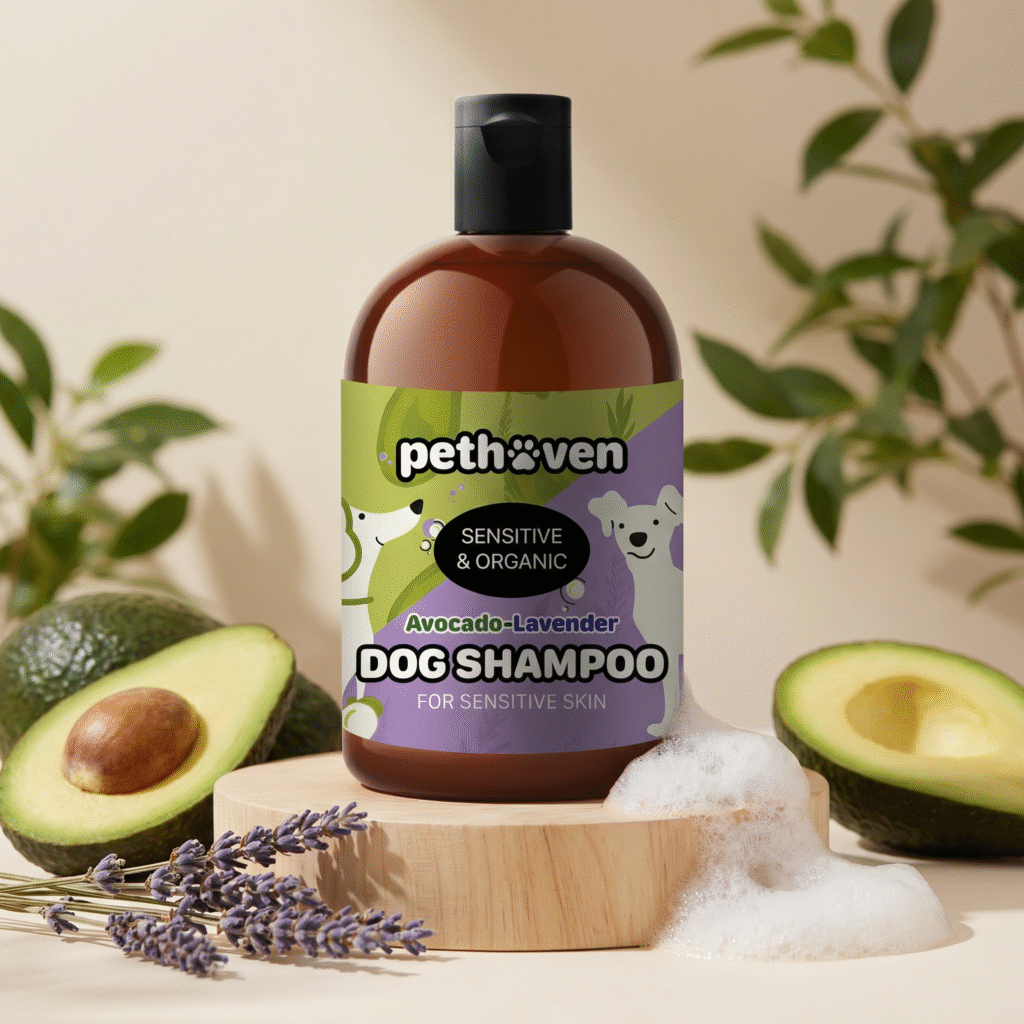 Avocado-Lavender Shampoo" title="Sulfate-Free Dog Shampoo: What It Actually Means and Why It Matters">
Common questions
Are sulfates dangerous or just irritating?
For most dogs at occasional use, they’re irritating rather than dangerous. The risk is cumulative skin barrier damage with frequent use over months and years, which can lead to chronic skin conditions.
Why does my sulfate-free shampoo not lather much?
Plant-based cleansers produce less foam than sulfates. This is normal and doesn’t mean the shampoo isn’t cleaning. The lather isn’t doing the cleaning — the surfactant is.
Are “natural” and “sulfate-free” the same thing?
No. “Natural” is essentially unregulated. A product can be marketed as natural while containing sulfates. “Sulfate-free” is more specific but, as covered above, still has loopholes. Read the ingredient list.
Can I use a sulfate-free human shampoo on my dog?
No — even sulfate-free human shampoos are formulated for human skin pH (5.5) which is too acidic for dog skin (pH ~7). The sulfate question is separate from the species question.